
Dr. Robert Bendavid Resident Research Award for Top Abstract
The Canadian Hernia Society is proud to introduce the Dr. Robert Bendavid Resident Research Award for Top Abstract, to be presented annually at the Canadian Surgery Forum.

This award honours the legacy of Dr. Robert Bendavid – a founding member and past president of both the Canadian and American Hernia Societies, long-time Associate Editor of Hernia: The World Journal of Abdominal Wall Surgery, and internationally recognized pioneer in hernia surgery.
Dr. Bendavid’s career was defined by innovation, scholarship, and mentorship. He advanced new techniques in hernia repair, designed surgical meshes, translated foundational anatomy texts, and published extensively. Known for his scientific rigor and ethical principles, his impact on hernia surgery worldwide remains unparalleled.
The award recognizes the top resident abstract in hernia or abdominal wall research, encouraging the next generation to pursue excellence in research and patient care in the spirit of Dr. Bendavid’s remarkable contributions.
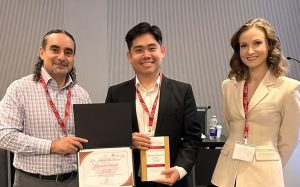
The Uptake of Laparoscopic Inguinal Hernia Repair in Nova Scotia, Canada: A 10-year Population-based Analysis
Ernest Chan1, Lynn Lethbridge1,2, Richard Spence1,2, Marius Hoogerboord1,2
1 Dalhousie University, Halifax, Canada. 2 Division of General Surgery, QEII Health Sciences Centre, Halifax, Canada
Abstract
Background:Laparoscopic inguinal hernia repair (LIHR) offers well-established advantages, including faster recovery and reduced postoperative pain when compared to open inguinal hernia repair. However, its uptake in many health systems remains inconsistent. This study examined trends in laparoscopic repair across Nova Scotia (NS), Canada over a ten-year period and identified patient, surgeon, and institutional factors influencing its use.
Methodology: A retrospective cohort study was conducted using population-level data from the Canadian Institute of Health Information Discharge Abstract Database and the National Ambulatory Care Reporting System. Adult patients undergoing elective inguinal hernia repair between January 2015 and December 2024 were included. Associations between surgical approach and clinical or system-level factors were examined using correlation analysis and hierarchical logistic modeling.
Results:Among 24,705 repairs, 5,730 (23.29%) were performed laparoscopically. The laparoscopic rate varied modestly over time and differed widely among surgeons and hospitals. Between-surgeon variation (21.26%, p = 0.006) exceeded between-hospital variation (1.40%, p = 0.419). Surgeons with higher overall procedural volumes were somewhat more likely to perform laparoscopic repair (Pearson Correlation Index = 0.14, p = 0.04 ). Female sex (OR 1.30, 95% CI 1.13–1.48) and lower comorbidity (Charlson comorbidity index = 0; OR 1.35, 95% CI 1.11–1.65) were associated with laparoscopic repair.
Conclusion: LIHR remains underutilized in NS, with substantial variation driven mainly by surgeon-level factors. Efforts to expand training and mentorship in minimally invasive techniques may help promote consistent and equitable access to laparoscopic hernia repair across the province.
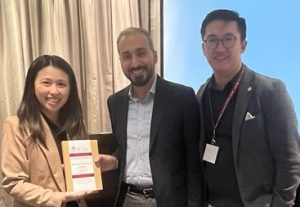
Dr. Ahmed Karmustaji is the inaugural recipient of the Dr. Robert Bendavid Resident Research Award. (Photo L-R: Dr. Daphne Lu, Dr. Ahmed Karmustaji, Dr. Ben Fung)
Quality Review of Ventral Hernia Repair Operative Reports
Abstract
Background: Operative reports are the definitive method for obtaining information regarding the details of the surgery and are essential for communication, optimal patient care, and research directives. Narrative operative reports are often poorly detailed and have been replaced by synoptic reporting in other surgical fields, however there is no standardized operative report details for Ventral Hernia Repair (VHR). We aimed to audit the quality of VHR narrative operative reports.
Methodology: A retrospective review of 283 VHR operative reports from a single academic tertiary hospital was performed for cases done between August 2019 to November 2024. Overall report completeness and reporting frequencies of VHR elements were compared. Variables were categorized into high, medium, and low importance variables.
Results: High volume surgeons performing ≥30 cases annually had overall higher documentation of all variables (91.40% vs 81.57%, p<0.001), particularly high-importance variables (99.03% vs 84.10%, p<0.001) and medium-importance variables (91.60% vs 74.91%, p<0.001). Staff dictation had higher documentation of high-importance variables compared to trainee dictation (92.11% vs 87.23%, p<0.001). EMR operative reports had higher documentation of size of mesh (94.74% vs 79.80%, p=0.038), DVT prophylaxis (79.55% vs 45.61%, p<0.001), and preoperative antibiotics (79.55% vs 45.61%, p=0.004).
Conclusion: VHR narrative operative reports demonstrated inconsistencies and incomplete documentation. High volume surgeons and staff dictation were more complete which indicates that better knowledge and experience of VHR results in better documentation and supports the trend towards major hernia surgeries being done at high volume centers. EMR documentation was better in auto-populated and prompted variables in the operative report template, this indicates that the implementation of a standardized synoptic operative report for VHR would enhance the quality of operative reports documentation.